Open Letter to Matthew Klein from an Investor Group

Dear Matthew,

I’m posting this on behalf of a group of C2 Investors, who have collaborated online to help one another navigate the platform and find the best systems to follow. While complaints about the platform come up from time to time, I think we all can agree that Collective2 is second-to-none for finding, evaluating and trading others’ strategies across a broad spectrum of trading instruments.

Many of us in the group feel that C2 could be doing more to protect subscribers, particularly newer ones, from high-risk strategies that are ticking time bombs. For experienced investors like us, we can look at the below chart and posted statistics to know that this ARK Futures system was a recipe for disaster:

Sure enough, it was:
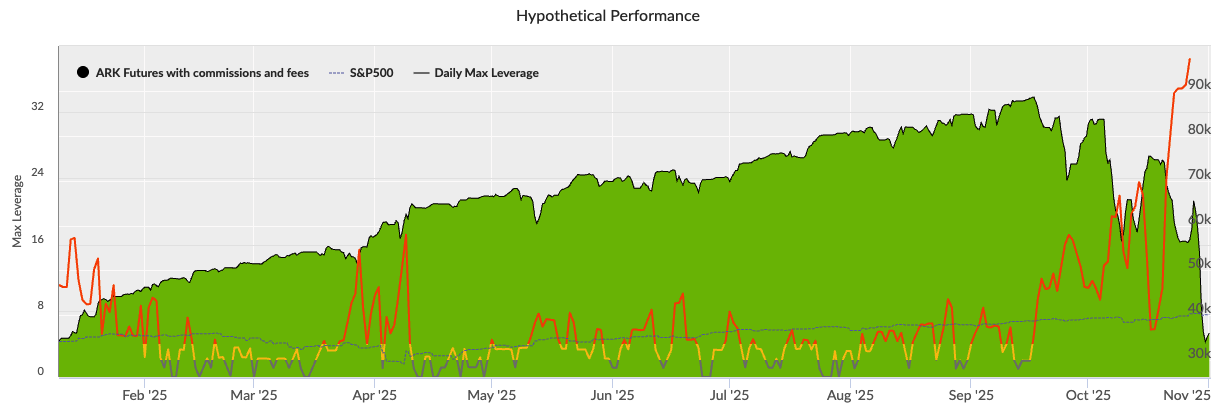
This scenario has played out countless times over the years (several times from this particular manager), resulting in millions of dollars of subscriber losses. What’s the common thread? Martingale systems that use excessive leverage to recover from drawdowns until they hit a drawdown that they can’t recover from.

It is especially concerning when some Strategy Managers, such as ARK2, appear to be making a career by exploiting subscribers for several years (see forum posts from 2022 and 2024), rinsing-and-repeating new high-risk strategies one after another when they blow up.

What’s the solution? We came up with a couple of ideas:

  1. Enforcing a leverage limit for non-TOS futures systems, such that trades that would result in surpassing the limit would be rejected. It is tricky, in that some legitimate systems trade with leverage as high as 20-to-1. Maybe the default limit could be 10-to-1 and managers could request a higher limit once they prove they need it.

  2. Same idea as #1, but enforce the limit on the subscriber side. The default maximum leverage for autotrading a non-TOS futures system would be 10-to-1, which would ignore system trades that cause this limit to be breached. The user could choose to increase this limit (preferably with some sort of warning given when they do).

We understand that the risks taken are always the responsibility of the trader. However, we would like to see Collective2 take more explicit action to protect investors by making it more difficult for managers to blow their accounts by reckless trading and/or take advantage of subscribers through rinse-and-repeat risky strategies. We hope you will give these ideas some thought, and we would welcome hearing any other ideas that you or other readers of this forum might have to address this issue.

Thank you.

Collective2 Investors:

garylynn2

StuartS

BrianW_

Tweety

Adides

JITF

O_H

CraigW

Speculatius

5 Likes

Oh my! This is a very formal forum post. I have never received an “Open Letter” before. Certainly not from a group of great customers whom I respect and hope to make happy.

There are some aspects of your proposals that I like, some that I think are difficult to implement in practice, and some for which I need clarification before I can react. But rather than respond off-handedly here in the forum, I have a different idea.

What if we have a real-time, open-to-all “C2 Virtual Town Hall” (or something with a better name). We can do it via a video Zoom. We can discuss this issue, and perhaps a few other issues people want to discuss; and we can have a reasonable debate and/or conversation. This would not be a social meet-and-greet, but a formal meeting with an agenda set beforehand.

I envision that people can submit topics for discussion/exploration. Maybe we choose between 2 and 4 of them, and everyone knows the topics beforehand. If one of the topics intrigues you, you can decide to come to meeting.

The reason I bring up this idea is because your proposal isn’t just a “product feature request” (although it is that, too). It also touches on the questions about what C2 is, who it is designed for, and what role is it meant to play. Just building features without having answers to these questions is a path to frustration. And look, sure, I have my own ideas about the answers to those questions. But maybe I should hear what you think.

Does anyone like the idea of a Town Hall? If the reaction is universally negative, I’ll drop it. But… maybe?

2 Likes

Personally I think C2 shouldn’t limit trade leader but allow trade followers all the tools to manage THEIR OWN RISK. Don’t subscribers already have full control on how much they are willing to lose (max DD before flatten?) And I think they can also set up warning notifications when DD hits specified %? Plus this strategy gave plenty of warning to jump ship and still come out ahead. Sure some strategies may just fall off the cliff, but again going back to my first two points.

At waht point do you hold followers accountable? Do your due diligence. IF you’re a noob investor, C2 is not the place for you. Invest in index funds. The purpose of C2 has always been to search for that alternative investments. Most traders lose, but there are few golden nuggests.You can’t have your cake and eat it too. Follow strategies with min 3 years track record..and don’t be a greedy follower

1 Like

Dear Gary,

I am as trader myself totally support this idea with maximum leverage 10:1. The leverage set up by default on C2 platform - 33:1 and even 100:1 for futures is something really crazy!!! Any trader, even the most conservative one, has this “seduction” of overleveraging and therefore exposing investor’s funds to a very high risk. To be frank, even leverage 10:1 is too high for an unexpirienced trader and may easily lead to a drawdown deeper than (-40%), let alone CRAZY leverage like 33:1 or goddamn demonic leverage 100:1. With kind of “conservative” reasonable leverage 10:1 any investor is gonna at least have some necessary time (a couple+ weeks) to leave a strategy and not being totally blown up within hours..

Hi Matthew,

Thanks as always for your timely and thoughtful reply. Speaking for myself, I love the idea of a virtual town hall. Count me in!

Gary

Alma: Just a slight detour from the main discussion – C2 does not “set up default leverage.” I think you may be misled by the fact that in some help text we mention that some futures contracts are levered 100:1, and forex trading is generally levered at 33:1. These leverage numbers are set by the exchanges, not C2. (Some further clarification: for example - look at the E-mini S&P contract. Its value is $50 per point. If the SP is at 6700, then if you buy one contract you “own” $335,000 worth of stock market exposure. You might only put up $2500 for daytrading that one contract… and so your leverage is 134:1 ! Notice this has absolutely ZERO relationship to C2. This is the nature of the financial product being traded.)

1 Like

This point gave me another avenue for a possible implementation. I assume the margin requirements for each contract are simply a table. You could have a more conservative table as the default and the exchange one as the high-leverage option. For example, I trade futures in an IRA at IB and the margin requirements are perhaps 2 times higher than with a standard account.

Not sure if this would be on the manager or subscriber side. I tend to favor a solution on the subscriber side to prevent breaking any legitimate systems, provided that the subscriber still has the option to take on the level of risk that they can now.

Just a thought to include in the virtual town hall…

I’d be interested in this discussion/virtual townhall!

I like the idea of a virtual town hall. Let’s do it!

Town Hall has been scheduled for next week:

Looking forward to the open forum.

Hello Matthew,

Thank you again for the call today. It was genuinely helpful to talk through several ideas for making Collective2 safer for subscribers without constraining the creativity of legitimate strategy developers.

I want to reiterate my support for Gary’s proposed solution, particularly the second option, which allows subscribers to set their own maximum allowable leverage, with the platform automatically ignoring trades that exceed that threshold. To me, this strikes the right balance between freedom and protection. Strategy managers can still run leveraged systems if they choose, while subscribers have the option to limit exposure to catastrophic leverage events caused by a rogue trader or a system malfunction.

I am fully aware that subscribers can already cap the number of futures contracts within C2, but that feature is insufficient. The notional value of futures contracts varies widely, which means that a simple contract count does not meaningfully constrain risk. A leverage-based limit would be far more effective and far more aligned with the realities of futures trading.

I also recognize there are technical challenges here, especially when incorporating leveraged ETFs, options, or multi-asset strategies where leverage becomes subjective. It may be helpful to sidestep those complexities, at least initially, by focusing exclusively on futures, where leverage is more straightforward to define and much easier to monitor in real time.

If the problem is narrowed to a futures-only implementation based on account equity and total notional value, does that make a solution more feasible? It could serve as a proof of concept that can later be extended to options and ETFs if appropriate.

I appreciate your willingness to engage with the community on this. There is a genuine appetite among subscribers for guardrails that improve safety without constraining innovation, and I believe this approach is a promising step.

Best,
Brian

3 Likes

Hi MK and Team,

Firstly, I wanted to thank you all for organizing the discussion. I think it was a great discussion that helped develop an understanding of both sides. As mentioned, my general concern is transparency, and with that goal in mind I thought of a couple of suggestions since then that I’d like to hear your thoughts on.

  1. The ‘latest activity’ section does not seem to show when users unsubscribe. Other than gleaning this from the live trading data (which is not so obvious), it might be beneficial from a product design perspective if there simply was a ‘current subscribers’ view for each strategy.
  2. I understand that “fake” accounts, created by SMs, can influence subscriber and review information on C2. To combat this, perhaps we could introduce an easy way to identify them? Possible suggestions.
    1. It’s made very clear when a subscriber has received promotional pricing (such as on the latest activity of a potentially new subscriber view).
    2. Badges/icons next to subscriber names based on some merits (active duration? number of subscriptions, etc).

Also, I had a pending question in the Townhall chat - does C2 use LexisNexis and other industry standard providers to vet SM identities? This could help avoid the concern of users creating new fake IDs etc.

Thanks again for your openness and time, looking forward to future discussions.

1 Like

Good discussion , another suggestion if i may , ban investors temporarily from joining new systems if one of the systems they are following crashed , this is a protection measure and a wakeup call so they dont jump from one system to another , like gambling pause 3 months six months whatever .

Another suggestion send periodic emails to subscribers to remind them to add a SL to the systems they are currently following if they didnt have one already .

Hi xyz we noticed that you didnt add a SL yet to your system xyz .

Another suggestion send a warning email to all subscribers if a system they are following crossed 50% DD or whatever .

Warn new subscribers if the developer is new , hey subscriber this system is run by a new developer are you sure you want to proceed .

Really beyond that its a subscriber choice at the end and they should be free if they want to chase high flying systems or new systems .

I wanted to try to keep this conversation going in an attempt to not lose momentum. There have been a number of good ideas raised and I thought maybe I would try to summarize the ones I have seen so that we can continue brainstorming. I think the overall goal is to try to provide the tools and/or safeguards needed for investors to be able to better identify and manage the risks associated with highly leveraged systems.

  1. Give subscribers the ability to set their own maximum allowable leverage, with the platform automatically ignoring trades that exceed that threshold (see post above by BrianWiksell). Perhaps a reasonable leverage limit should be set by default and the user could raise (or disable) it. There is the ability to set the maximum number of contracts, but not all contracts are created equal (e.g., NQ has 10 times more leverage than MNQ). Also, this setting only limits the size of a single position and not the overall portfolio position.

  2. Come up with some sort of community-based rating system based on various metrics. Right now, the review system is only open to current subscribers. Those subscribers are generally happy and write 5-star reviews until the system blows up, but by then those 1-star reviews are too late. The thought is that knowledgable C2 investors could have some sort of rating system available to them to give good ratings to ones they like, or flag high-risk systems that may not appear very risky to the novice C2 subscriber.

  3. The Strategy Managers could define a set of metrics that they would adhere do (e.g., leverage limit, position DD limit, etc.) and the system would flag those systems that broke their own rules. A good addition to this from the post by PropSolutions above – send all subscribers an email whenever those rules are broken so they can take action right away.

  4. Add more transparency with regards to the current subscribers (see post above from OmarHafez). Knowing that a system has a lot of experienced, full-paying subscribers could be useful information when trying to determine if a system is legitimate.

  5. Add a backtest button to the autotrade control panel. The idea is that the user would set the scaling, stop losses, max position size, etc., and the system would run a backtest on the historical data and provide all of the relevant performance statistics. This could be a very useful tool for both novice and advanced users to be able to determine the best settings for their account size and risk tolerance. Right now advanced users have to analyze the CSV data in Excel to estimate the effects of position sizes being rounded/clipped and stop losses being hit.

This is not a complete list of the ideas brought up, but I’m hoping it is a good enough start to keep the conversation going and perhaps one will take hold and eventually be developed.

3 Likes

To better identify and manage the risks associated with highly leveraged systems, we need to understand that the leverage in E-mini futures (and all futures contracts) is different with margin in the stock market. We can’t get confused with this difference.

Mathew already explaned this is the nature of the financial product being traded.

Here’s a further breakdown of where the leverage originates:

1. The Core Source: The Performance Bond (Margin)

· It’s Not a Loan: When you trade stocks on margin, your broker lends you money to buy more shares. In futures, you are not borrowing money to purchase the underlying asset. You are posting collateral (margin) to ensure you can fulfill the contract’s obligations (either to buy or sell at a future date).

· Small Control of Large Value: The leverage is the ratio between the notional value of the contract and the margin required to control it.

· Example: One E-mini S&P 500 (ES) futures contract has a notional value of S&P 500 Index Price * $50. At an index level of 5,000, one contract controls $250,000 of notional exposure.

· The exchange (via your broker) requires an initial margin of around ~$12,000 (this fluctuates with volatility) to enter the position.

· Result: You control $250,000 of exposure with about $12,000 of your own capital. This is a leverage ratio of approximately 20:1.

2. The Legal Structure: A Binding Future Agreement

The futures contract is a standardized legal agreement between two parties (you and an anonymous counterparty, with the clearinghouse in between) to exchange an asset at a set price on a future date. Because the actual exchange of the full notional value happens in the future, you only need to prove your creditworthiness today with the margin deposit. This time delay is the inherent source of leverage.

3. The Role of the Clearinghouse (CME Group)

The clearinghouse is the critical intermediary that enables this leverage safely:

· It becomes the buyer to every seller and the seller to every buyer, eliminating counterparty risk.

· It sets and adjusts the margin requirements based on market risk.

· It enforces daily mark-to-market settlement, which is key to managing the risk of leverage.

4. Daily Mark-to-Market: The Engine That Manages Leverage Risk

This is how the system doesn’t collapse under its own leverage:

· At the end of every trading day, all positions are “marked to market.” Your gains or losses are calculated and settled in cash immediately.

· If your loss reduces your account equity below the maintenance margin level, you get a margin call and must deposit more funds immediately (often by the next morning) or your position is liquidated.

· This process resets the position’s cost basis daily and ensures losses don’t accumulate beyond a participant’s collateral.

Key Implications of This Leverage:

· Amplified Gains & Losses: A 1% move in the S&P 500 index (50 points) equals a $2,500 gain or loss on that one ES contract ($50 per point). Relative to your $12,000 margin, that’s a +20.8% or -20.8% swing in your capital.

· Margin Calls are Frequent & Mandatory: Unlike stock margin, futures margin calls typically require immediate action. There is no “grace period” to deposit funds.

· No Interest Charges: Since you are not borrowing money, you don’t pay interest on the leveraged amount. However, your margin deposit does not earn interest while tied up as collateral.

In Contrast: Stock Market Leverage

To make the source clearer, compare it to buying stock on margin:

· Stock: To control $100,000 of Apple stock, you might put up $50,000 and borrow $50,000 from your broker. You **pay interest** on the $50,000 loan, and you own the actual shares.

· E-mini Future: To control $100,000 of S&P 500 exposure, you might post $5,000 as performance bond. You pay no interest, but you own a contract, not the underlying stocks.

So, you can’t expect to control emini’s leverage as it does with margin in the stock market.

1 Like

Giving a few members the power to flag systems left and right maybe is not the best idea . A simple rating/reviews system will suffice .

I didn’t mean to imply that only a few members would have the power to rate a system – it would be open to all. Of course there is the potential for fake ratings, but not sure how that would be prevented.

I think that’s generally a good idea. From a manager’s perspective, I would like to have the ability to respond to such comments. A subscriber might be mistaken or might have applied something incorrectly. I believe the ETFTimer manager mentioned something like this in the Town Hall as well.